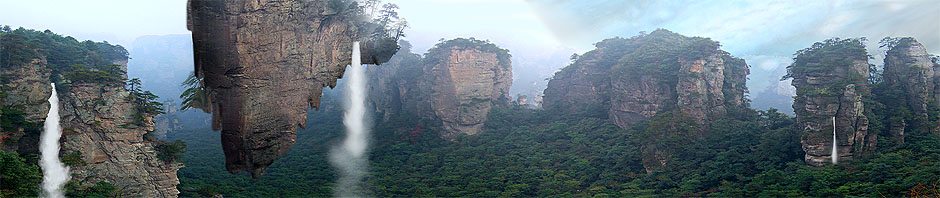
Na’vi Digital Archive Project: Survey results, new direction

Hello again,

Following up on the June 23, 2026 post about the Na’vi Digital Archive Project, Jay Edwards has asked me to convey the following to the Community:

Jay writes: “As you know, we released a survey to the community to get a better feel for how they were feeling and what they wanted to see from the archive going forward.

“Based on the results, we have decided to shift the direction of the project. [Here are] some of the results from the survey, as well as a description of the new version of the archive.”

Survey Results

Updated Project Description

For feedback to Jay and/or further discussion, please use the comment section below.

Posted in General | Leave a comment

Ulte säwäsulä ayyora’tu leiu . . . And the contest winners are . . .

Kaltxì, ma frapo!

It’s my pleasure to present to you the four winners of the recent Na’vigation Writing Competition, along with their winning entries.

Ma eylan alu Paeyte; Kalto’me te Tareptu, Sye’lì’an’ite; Keyai; sì Luta:
Seykxel sì Nitram, ulte Seysonìltsan!

I continue to be so impressed by the Na’vi mastery and creativity shown by so many members of the lì’fyaolo’. Your poetry, stories, essays, translations, learning materials of all kinds . . . ayngeyä sìkangkemvi alor oeru var teya sivi.

Enjoy!

Poetry Beginner: Koaktuä Syena Tìmusakto by Paeyte

‘Amongeiokx oe txepta

Tasyätxeiaw oe txepne

Oe lu koak to oeyä ayolo’tu

Txo oe ke tätxaw, fkol oeti ke fwayew

Ikran oeyä tayätxaw nì’awtu

Oeyä fwusewa ayskxirìl a zoslarmu tìsomit new

Oe zup raw txepramä sänrr asom

Tìsomìl ‘eykìp nìwin tsngawpayt oeyä

Oeyä ikranìl oeti nerìn tengkrr po längeym

Eywa’eveng lrrtok si ulte hiup txekxumpay nefä

Oel omum futa oe slereiu ne txepìva

Oel zeiyìm srawa kxitxit afyole

‘Almongeiokx oe txepta

Tìlmätxeiaw oe txepne


Poetry Advanced: Txeptsyìp by Kalto’me te Tareptu, Sye’lì’an’ite

Txeptsyìp

Txana tìreyti,  tìng oeru ngal, sì txana hoanti.

Emrerey oe ngatalun wewa txonmì.

Palon nga na tsawke framomì, frangipmì.

Tsun kivä fu ziva’u nga tsìk na sätsyìsyì.

Yewla lu oer, yewla nì’aw, krra nga kä.

Ì’awn oehu. Rä’ä wrrkä.

Paskalin oey, Yawntu oey, ma Oeyä Txeptsyìp.

Txep

Txepna nga nrr, nerekx txe’lanti oey.

Eo atan ngey, lrrtok seiyi oe.

Paskalin oey, yawntu oey, ma Oeyä Txep.

Txeva

Txeptsyìpti tolong, Tayong frayteptsyìpti.

Eyawrfyari fraytepti zene tivong ulte txevar ‘on si.

Ve’kì rä’ä txevati a ngop ayvawmpinti.

Afpawng si nì’it nì’aw, nì’it nì’aw, Ma ‘eylan


Prose Beginner: Tìrun A’o’ by Keyai

Ro ha’ngiro, fwampop tarmìran kxamlä na’rìng. Fkip fìwopx peyä ‘eylan alu ikran tswerayon.

Ikran tswayon ne fwampop ulte syaw fwampopur san oel tse’a vawma pìwopxit ahiyìk sìk.

Krra fwampop tìng nari, pol tsole’a pìwopxit ahiyìk. San tsa’u lu kxener sìk po syaw ‘eylanur.

San lu txep srak? sìk, ikran polawm.

San skxakep sìk, ‘eyng fwampop, san Srake sweylu txo oeng livang sìk?

San oeng pivawm aylaheru ma fwampop.

San tam. Kä ko!

Krra mefol stolarsìm mefeyä eylanit alu fwäkì sì ikranay sì kali’weya sì kenten, ayfol lawk txepit sì teyngta pehem si ayfo. Fo wäte txankrr taluna fwampop sì kenten new livang slä ikranay txopu si ulte kali’weya ke ‘efu txeym. Fwäkì lu txantslusam ulte frapo tìng nari poru.

San oe fpìl sìk po plltxe, san sweylu txo ayoengal lang tsatsengit ulte slu am’ake teri fwa txep ke vìyirä.

Frapo mllte hu fwäki ulte hum. Fwampop sì kenten fäkä sìn ikranä txal ulte kali’weya sì fwäkì tswayon fa ikranay. Ayfo polähem nìwin. Kentenìl txepit sngä’i nivìn mawkrra ayfo lu am’ake teri fwa tsa’u ke vìyirä. Pamìl kentenit speykä slä pol fpìl futa txep eltur tìtxen si.

San fì’uä sänrr leiu lor! sìk syolaw kenten.

San ulte fì’u sleykeiu sang yati sìk plltxe fwampop.

Frapo sngä’i uvan sivi pxaw txep. Ikranayìl ferewi fwampopit. Kenten srerew. Ikranìl ‘erem tsnganit a sunu poru frato. Tsakrr, ayfol stawm tsngusawvìka tuteoti ro reymtxew. Lu ilu!

San ngari peu ma ilu? sìk polawm kali’weya.

San ayngeyä hem lu ‘o’ nìtxan ulte oe new uvan sivi nìteng slä txep ke tsun slivelänge ulte oe ke  tsun kivängä sìn atxkxe. sìk plltxe ilu. Txantslusama fwäkì poleng ikranayur san run vulit sìk sì fwampopur san ngop apxa txatxit sìk. Fwäkìl yolem txeptsyìpit nemfa txatx vulfa.

San set txep leiu paymì sìk plltxe fwäkì. Ilu ‘efu nitram nìtxan. Ayteptsyìp lu lor ulte fì’u lrrtok si na tsawke. Ye’rìn, txatx slu hì’i ulte txeptsyìp spakat. Ilu irayo si fwäkìru sì peyä eylanur.

Tsìk, Na’vi alu Neytiri pähem. Peyä keyrelìri ‘ur fkan nìsti. Po fyolufye txepur ulte tsìsyì san sawtute pak sìk. Mawkrr, Neytiri hum.

Tsaw loho fraporu ulte fo ‘olefu keftxo nì’it ulte heyn nenimì.

Tsakrr, ilu syaw san nìn fì’ut a oel rolun sìk tengkrr pol fyerep tstalit lefngap tawtuteyä. Slä hayalo alahe. 🙂


Prose Advanced: Rammì, kem si nìNa’vi by Luta

Pamrel sìlmi oe teri Uniltìrantokx apxeyve. Kolan, txep sì txeptsyìp, lolu sìltsana säfpìl fwa tsawteri pamrel si. Keng lolu oer ‘awa vur ronsemmì, slä fìkintrr lolen ‘uo txanlokxemì oeyä ulte zene oe tsawteri pamrel sivi set.

Kelku si oe Espanyamì. Frapol a fìtsenget tok li tsat omum, slä kxawm sutel futa fìtsenge lu pxaya txeptseng ke omum. Frazìskrrsom, tsrayo nekx. Lu txasom fìtxanlokxemì kuma txepìl ayna’rìngit nekx nìftue nìhawng. Frazìskrrsom, suteol kelkuti sneyä han fìlunta. Aylun a tsata fì’u len lu pxay: Krro krro, suteo kä ayramne fte sivyor ulte ylltxeptsyìpit ngop. Zene oe piveng ayngar futa, nìfkeytongay, fwa tsakem si lu kxanì nìwotx mì aysengo fìlunta, slä ke lek sutel ulte tsaylltxeptsyìp a lolu hì’i, tsawl slu ulte sngä’i fra’ut nivekx.

Lahea sute lu kezemplltxe skxawng nì’ul (txo tsaw tsivunslu) ulte new nì’aw fra’ut skiva’a. Fo kä ayna’rìngne ulte ngop txepit. Keng fkeytolok (nìkeftxo) sute a peyä tìkangkem lu fwa txepit tong (tsaysute alu firemen) a ngop txepit fte livu foru tìkangkem. Fì’u lu keftxo frato.

Ka wotx, sutel ayna’rìngit leytslam. Tse, kxawm kehe, slä ke new fo kelkuti sneyä hivan, slä tsun fko pivlltxe san ka wotx, sute fìkem ke si sìk. Slä lu nìteng tsafnetute a ke leytslam ke’ut, a sunu foru fwa fra’ut ska’a, a fori ke tsranten ke’u sì kawtu. Frazìskrrsom lu txep ka wotx Espanya. Sute terkup, slä ke lu awngar Firemen nì’ul taluna, komum oe, tse, ayeyktan lu skxawng nìhawng (fu ke new fo kekem sivi). Tengkrr, sute sì ioang tererkup.

Fì’uteri tsun nì’aw pivlltxe san rutxe, fìkem rä’ä si. Lek horenit krra nga ayramne kä, leytslam na’rìngit ioangitsì. Kem si nìNa’vi.

Posted in General | 3 Comments

Na’vi digital archive project: Survey of the lì’fyaolo’

Kaltxì nìmun!

As many of you know, Jay Edwards, a graduate student working under the direction of Dr. Christine Schreyer at the University of British Columbia, is developing a Na’vi digital archive. Jay and Christine have asked me to share a survey with you related to that project.

Jay explains the questionnaire as “a short survey . . . [to] learn more about the community’s thoughts on the Na’vi digital archive project. The survey has only 20 questions, which should only take approximately 10-20 minutes, and is fully anonymous unless participants choose to provide their name. We’ve gotten approximately 41 responses after reaching out to Kelutral and LearnNa’vi, and I’m hoping to get that number up to 50 . . .”

If you’d like to share your thoughts on this topic, either under your name or anonymously, and haven’t yet done so, please use this link:

Survey Link: https://ubc.ca1.qualtrics.com/jfe/form/SV_08tALU3EAG4h4t8

Irayo, ma frapo!

ta P.

Posted in General | Leave a comment

Tskxekeng a mikyunfpi: Pamrel Listening exercise: Text

Kaltxì, ma frapo!

I hope you’ve had fun trying to decipher the Na’vi for the communication episode of Expedition Pandora! I certainly had fun in putting it together.

Congratulations to Zángtsuva, Txonpay, and everyone else who took a crack at this. I glanced briefly at the forum posts but didn’t examine them carefully: as you know, I generally keep away from the forums because I don’t want anyone to think I’m “looking over their shoulder.” But I saw some perceptive analysis. Seysonìltsan, ma smuk!

Several factors made this text particularly challenging. First, it contains abstract language in long, sometimes convoluted sentences. In translating the narration, I tried to be faithful to the English original, but on occasion I departed from it a bit so that the Na’vi would sound idiomatic and (hopefully!) feel natural to a native speaker on Pandora.

Also, you probably heard some new vocabulary, words you hadn’t encountered before. I think there were about 20 of those. Some were derivations from existing roots, but others contained new roots. See if you can identify those new words. I’ll introduce them as new vocabulary in a subsequent post.

Finally, some of my reading was pretty fast! In making the original recordings, I didn’t time anything: I just recorded the narration as I usually would, then submitted the mp3’s to the tech people for them to match the words to the video. You see the potential problem here: The time it took to say a particular Na’vi sentence didn’t always match the time for the corresponding English one! (I know everyone is thinking about Tsu’tey’s Na’vi interpretation of Jake’s rally-the-clans speech at the end of A1! 🙂 ) It was up to the techs to make everything fit properly. I thought they did a phenomenal job with that. But at times it required speeding up my reading a tad. All in all, though, I think it sounds quite natural.

I’m sure many of you will have questions, so leave your comments and I’ll answer them when I can.

For now, though, let me say a word about kaltxì.

As you saw or will see, I’ve used it in this text as a noun meaning ‘a greeting’ or ‘a hello.’ We know it’s a noun because it takes case endings (kaltxìti). The question regards how this squares with my previous pronouncement. From the forum:

Original Question: Is kaltxì   valid noun for “a greeting”? kaltxì si is the only example of a si-verb where there is no corresponding noun or adjective. We all know kaltxì functions as an interjection, in the same way that irayo functions as an interjection, however irayo is also an attested noun for thanks/a thanking [which forms irayo si], where kaltxì is not.

Quote from: Karyu Pawl For now, though, I’ll just say that kaltxì can’t be used as the noun for ‘greeting.’ We need a different word for that. (I’ll add it to my list. )

Well, there are times when you just have to admit you were wrong. I don’t recall why I was so adamant six years ago that kaltxì couldn’t also be a noun alongside its use as an idiomatic expression, just as we can say in English, “When I saw her, she gave me a big hello.” But when I needed a word for “greeting,” I decided on kaltxì rather than coming up with a new root. And part of what persuaded me was indeed the realization that kaltxì si was the only si-verb where the non-verbal part wasn’t a noun or adjective. So yes, kaltxì can be a noun, and we’ll add that to the dictionary listing.

In my defense, some of you may be familiar with this famous quote from the 19th century American philosopher Ralph Waldo Emerson, who in 1841 wrote: “A foolish consistency is the hobgoblin of little minds.” 😀

Ayngaru tsapamrel:

Hayalovay!

ta P.

EXPEDITION PANDORA Episode 9—Na’vi Translation

  1. A word of kindness [NEYTIRI: I see you.] A welcoming gesture. A seeing glance.

Lì’u atìtstunwinga’. Tatìp atì’eylanga’.  Säru’u a kame.

  1. For the Na’vi, language transcends the spoken and the written.

Na’viri lì’fyal nuäslew aylì’ut apawnlltxe sì pamrelit.

  1. Communication is far more than a matter of words.

Tìsäfpìlyewn ke lu aylì’u nì’aw.

  1. As with any ecosystem, the inhabitants of Pandora communicate in ways unique to their environment.

Na frave’o aruseyä, farwuntu Eywa’evengä säfpìlyewn nì’awnì’aw fa ayfya’o a tare fey pxawngipit.

  1. For the Na’vi, speech is but one thread in a larger tapestry. One woven with sounds, gestures, songs, and memories.

Na’viri tìplltxe lu ’awa kìng nì’aw mì sätäftxu atsawl nì’ul—pumit a fkol täftxu fa ayfam, aysatìp, ayway, sì ayok.

  1. Throughout Pandora’s various clans, only one language is spoken.

Ka leketengsyona ayolo’ Eywa’evengä, plltxe fko ’awa lì’fyafa nì’aw.

  1. The language of the Na’vi is consistent, despite the exo-moon’s varied landscapes and the vast expanse between clans.

Lì’fya leNa’vi lu tengwotx, ken ayreymsätsa leketengsyon Eywa’evengä, ken hoeta tayo a mìkam ayolo’.

  1. While minor dialectical differences have been observed, particularly between the coastal clans and the forest-dwelling clans, the linguistic uniformity is a rarity for any sapient species.

Hufwa fkeytok hì’ia sìketeng a mì aylì’fyafnel, nìpxi mìkam ayolo’ lereymtxew sì ayolo’ a parwun na’rìngit, fìtìtengwotx lì’fyayä lu säkelpxìmrun kip ayfnerusey afpusìl.

  1. Human xenolinguists have attributed this single language development to the Na’vi’s exceptional and rigorous oral culture.

Ìlä sìftiatu aylì’fyayä hifkeyä alahe, lun tìmimuä lì’fyayä a’aw lu keltrrtrra reyfya apawnlltxe suteyä leNa’vi.

  1. Through their connection to Eywa, the Na’vi used mnemonic Song Cords and ceremonial singing to communicate stories through generations.

Fa sneyä sätare a hu Eywa, solar Na’vil aywaytelemit sì tìrusolit a’eoio fte ayvurit säfpìlyivewn ayswayìka.

  1. It shows that even without a written component to their language, nothing is forgotten.

Wìntxu fì’ul futa keng pamrelluke mì lì’fya, ke tswa’ fkol ke’ut.

  1. This consistent use of song and the powerful bonds created via tsaheylu have enabled the Na’vi to preserve histories going back almost 18,000 years. [NEYTIRI: My grandfather’s grandfather was Toruk Makto.]

Fa tìsar atengwotx tìrusolä sì aysäyìm atswalnga’ tsaheyluä, Na’vi tsolun swiveyn ayokrolit stum zìsìto amrrzazam.

  1. This method of communication allows for a living memory of the Na’vi people.

Fìfya’ol tìsäfpìlyewnä tung ’okit arusey suteyä leNa’vi.

  1. A way to see beyond the present. Beyond what’s in front of them. It gives weight to the words “oel ngati kameie” Or I see you.

Lu fya’o fte tsive’a nuä sekrr, nuä ayzum a ayfoeo. Tìng wawet aylì’ur alu Oel ngati kameie.

  1. A greeting, but also a declaration of recognition, of presence, and of understanding.

’Awa kaltxì lu, slä lu kop sätxurplltxe tìlätekä, tìtokä, tìtslamä.

  1. When the Na’vi see each other, they’re not just bearing witness to another, they are perceiving them and their life. What connects them beyond the physical.

Krra Na’vi käpame fìtsap, ke plltxe nì’aw san tse’a oel futa eo oe nga kllkxem sìk. Tutel a’aw ’efu tìreyti tuteyä alahe fa sätare a lu nuä hifkey letrrtrr.

  1. Often words this strong require some form of gesture to accompany it.

Aylì’ul atswalnga’ fìtxan pxìm kin fnetatìpit sko sìhuslew.

  1. The Na’vi often pair the greeting by extending one hand to their forehead and bringing it back down to the other.

Fte kaltxìti huslivew, Na’vil pxìm tspu’ tsyokxit ne zare’ tsakrr zeykup nekll.

  1. The Na’vi are no strangers to these more silent forms of communication.

Fayfnetìsäfpìlyewn atìfnunga’ smon Na’viru nìtxan.

  1. Their gestures, shaped by their unique four digit hands, form a subtle and expressive sign language.

Fey satìp a fko ‘on si fa tsìnga zekwähu a tsyokx le’awnì’aw slu weseka lì’fya a yewn nìno nìfnusì.

  1. Coastal clans of Na’vi make particular use of this silent expression, which aids communication during underwater endeavors,hunts, and ceremonies.

Ayolo’ìl lereymtxew Na’viyä sar nìpxi tìfnunga’a fitìyewnit a srung si tìsäfpìlyewnur krrka aysätaron sì aysä’eoio a len mì fay.

  1. Like much of Na’vi culture, the natural world plays an invaluable role in how their language develops.

Na tsawla hapxì reyfyayä leNa’vi, kifkey txanley mì sìmimu lì’fyayä feyä.

  1. At sacred sites like the Hometree, Na’vi language extends beyond words to reflect a living relationship with the land, where memory and song help carry the histories of the Na’vi through time.

Ro ayswotu a na Kelutral, lì’fya leNa’vi tspu’ nuä aylì’u fte tivìng rì’ìrit ruseya sätareyä a hu atxkxe, tsenga ’ok tìrolsì srung si fte hivena ayokrolit Na’viyä ka krr.

  1. For the Na’vi, language is more than a tool.

Na’viri ke lu lì’fya sä’o nì’aw.

  1. It is a bridge, one that connects clans, community and generations.

Lu semkä a tare ayolo’it sì ayswayìt.

  1. As we continue to explore this wondrous exo-moon, perhaps it can also be a bridge between our world and theirs.

Tengkrr verar awnga livang fìtsenget akosman, tsivun kxawm tsa’u slivu semkä a mìkam kifkey awngeyä sì pum ayfeyä.

Posted in General | 13 Comments

Tskxekeng a mikyunfpi   A listening exercise

Kaltxì, ma eylan!

The culmination of a project we’ve been working on for some time is now available on YouTube. Episode 9 in the “Expedition Pandora” series, the one on communication, is now available in Na’vi—in fact, in Na’vi nì’aw!

The idea behind this project came from Josh Izzo at Lightstorm, who thought it would be fun to have a version of the communication episode entirely in Na’vi, without subtitles, as a gift to the lì’fyaolo’. Of course I agreed enthusiastically and began working on the translation. Once it was complete, I recorded the text, and the techs at Wild Card Creative Group, who work with Lightstorm, integrated it into the video. I think they did a fine job.

As a (hopefully enjoyable!) listening exercise, this narrative contains a fair amount of abstract terminology and isn’t always easy to decipher. Along the way, you may discover a new root or two. But the effort will be worthwhile! At some point I’ll post the entire text, but right now I think it’ll be more productive to see how far you can get without a crutch. (The English version of Episode 9 is readily available, but try to resist the temptation to turn to it too soon! 🙂 )

I hope the accuracy of the grammar and pronunciation is high! But as you all know very well, I’m hardly perfect, so if you discover any goofs, please let me know. 😀

Fìstä’nìpamit yivune nì’o’ nì’aw!

ta P.

Posted in General | 6 Comments

Hì’ia tìsung postä aham    Follow-up to the previous post

Kxì, ma frapo!

In the previous post, some questions that came up in the comments were left hanging. Rather than answering them there, I thought I’d do that here, since I don’t won’t anyone to miss them.

RN U VS. Ù

Thank you to Zángtsuva, Txonpay, and the others who pointed out that I haven’t been consistent in marking new vocabulary for u vs. ù in Reef Na’vi. Going forward, I’ll try to remember to do that. As before, if a word containing u is not otherwise noted, you can assume the RN version is u. Only words that have ù in RN will be called out.

New or recent words with ù in RN:

lemùngwrr
parwùn
fleyùl

Mangkuan, ’ulte, and <uy> are u in RN, not ù. And to confirm Záng’s assumptions, yes, derived words like wätùm and utùrtu have the expected pronunciations based on their etymologies, and we still have no exceptions to the tendency that ù does not occur at the end of a word.

THE ORDERING OF FINAL -PE AND CASE ENDINGS

This deserves some discussion.

The question came up in this example sentence:

Ayioangìlpe fìsponot parwun?
’What animals inhabit this island?’

As you know, ayioangìlpe ‘what animals’ is in the Agentive case. The breakdown is:

ayioang (animals: noun) + ìl (Agentive case ending) + pe (interrogative particle)

Several people felt the ordering of ìl and pe should have been the other way around: ayioangpel.

It’s remarkable to me that after all this time, there are still basic questions to be asked about grammar and structure! In this case, the question is:

When interrogative <pe> is a suffix, does it precede or follow case endings?

I don’t think there’s an immediately obvious answer to this question. Na’vi could go in either direction. Although I’m leaning one way, before I make a ruling I’d like to get your input—whether you feel strongly it should be this way or that, and why.

As some people noted, we have a possibly parallel situation with the -o suffix. In Wiliam Annis’s authoritative Horen, the rule is stated clearly:

3.1.3. Indefinite -o. A noun may take the indefinite suffix -o, one, some. Case endings follow the -o, such as puk-o-t.

So if -pe is analogous to -o, we’re done: it’s noun + pe + case endings. But are -o and -pe really parallel? Or perhaps the question is, do they need to be treated as parallel?

Before anything else, if anyone knows of a canonical example where one or the other of these orderings is found, please let me know! We should be consistent with what’s already been established. But I haven’t been able to find such examples, so at this point it’s an open question.

To facilitate your thinking, consider these examples:

1. Which teacher gave you that book?
A. Peharyul tolìng ngar tsapukit?
B. Karyulpe tolìng ngar tsapukit?
C. Karyupel tolìng ngar tsapukit?

2. Which book did the teacher give you?
A. Karyul tolìng ngar pefukit?
B. Karyul tolìng ngar pukitpe?
C. Karyul tolìng ngar pukpet?

3. To which student did the teacher give that book?
A. Karyul tolìng tsapukit penumeyur?
B. Karyul tolìng tsapukit numeyurpe?
C. Karyul tolìng tsapukit numeyuper?

4. To which teacher’s student did you give that book?
A. Ngal tolìng tsapukit numeyur peharyuä?
B. Ngal tolìng tsapukit numeyur karyuäpe?
C. Ngal tolìng tsapukit numeyur karyupeyä?

Items 1 through 4 illustrate <pe> with the Agentive, Patientive, Dative, and Genitive case endings respectively. In each item, A has <pe> as a lenition-triggering prefix, where there’s no controversy. B and C have <pe> as a suffix. In B, the ordering is case ending + pe. In C, the ordering is pe + case ending.

Looking at the B and C versions, which seem more natural to you? Which do you think would be easier to understand and process in conversation? Do you have a gut feeling about which one is preferable?

Let me know in the comments!

ta P.

ADDENDUM    18 April

Tewti! Tìpängkxo akosman nìtxan nang!! Irayo seiyi oe ayngaru nìwotx, ma eylan!

What great comments! Thanks so much to each one of you who contributed. I can hardly imagine a more intelligent, informed, and helpful discussion. Lì’fyaolo’ri awngeyä leiu oeru nrra nìtxan!

I’ve now read through all the comments (well, TJ-K, I’m still working on yours, but I’ll get there! 🙂 ). I’ll try to respond to all of them individually, although it may take a little time. But for the present, let me tell you my conclusions.

Although a few of you preferred the B versions, where pe was in final position, and provided well-considered arguments for that choice, most preferred the C versions, with the case endings final. Since it became clear that (1) the C-version is the ordering that’s been taught up to now, (2) most people feel more comfortable with C, and (3) most persuasively, we have canonical examples of C, which I had forgotten (’upet, tupel, yìpet), C will be the standard ordering. That is,

When interrogative <pe> is a suffix, it precedes case endings.

Accordingly, I’ve changed the example in the previous post to ayioangpel.

That said, I believe there are situations in which some speakers may come up with B-type orderings spontaneously. (See Neytiri’s interesting example in the previous post.) But those will be considered non-standard.

A bit more, if you haven’t already had your fill:

I suspect one of the reasons *ayioangìlpe sounded right to me when I wrote the previous post was influence from another language. As research for a language project I’ve been working on, I’ve been looking closely at Finnish, a non-Indo-European language I’ve found extremely interesting but also quite a challenge. (It has 15 cases!) In Finnish, you have forms like this:

autossani ‘in my car’

The breakdown is:

auto ‘car’

autossa ‘in a/the car’

autossani ‘in my car’

Importantly, <ssa> is not a postposition but rather a case ending (the Inessive case). So in this language, case endings are not necessarily word-final. That fact may have unconsciously influenced my thinking about Na’vi.

There’s more to say about how <pe> interacts with adpositions compared to how it interacts with case endings, but I think that’s enough for now. 🙂

Edit 4-20-26: In headline, postìyä –> postä. Irayo, ma Tekre.
Posted in General | 33 Comments

Tsìvola lì’u amip          Thirty-two new words

Kxì, ma frapo!

It’s too late for me to wish people Happy Easter or Happy Passover, but for those who celebrated, I hope you had a pleasant and meaningful holiday.

As you’ve probably gathered, I’ve been busy with time-consuming projects that have temporarily taken me away from Na’vi. Happily, though, they’re mostly complete, so I can turn once again to my major conlang love. 🙂

We haven’t had any new vocabulary in quite a while, so here’s a start: 32 words. Some of these are predictable “housekeeping” items—obvious derivatives of existing items that should be in the dictionary. But most are entirely new, largely stemming from a translation project someone asked me to do. (That’s the best way to discover the gaps in a conlang, I think: to realize while translating that we really do need a word for X!)

I should reiterate that I have a significant backlog of LEP submissions I need to get to. Although those suggestions don’t figure among the new words below, I haven’t forgotten about them. As always, LEP members, thanks for your patience!

In no particular order:

le’awnì’aw (adj., le.’AW.nì.’aw) ‘unique’

This is ‘unique’ in the sense of exclusivity: there’s no other item in the world like the one in question. Compare that with letsim, also glossed as ‘unique.’ Letsim, however, indicates ‘original, not derived from another source.’

Tsatìoeyktìng lu le’awnì’aw; kea pumit anafì’u ke stolawm oel kawkrr.
‘That explanation is unique; I’ve never before heard one like it.’

tì’awnì’aw (n., tì.’AW.nì.’aw) ‘uniqueness’

säkelpxìmrun (n., sä.kel.PXÌM.run) ‘a rarity’

As you would conclude from the sä- prefix, this word refers to a particular instance of being rare. It’s often pronounced colloquially as skelpxìmrun.

Nafì’ua mokri lu säkelpxìmrun.
‘Such a voice is a rarity.’

tìkelpxìmrun (n., tì.kel.PXÌM.run) ‘rarity, rareness’

The tì- prefix here indicates the state or quality of being rare.

Tìkelpxìmrunit nafì’ua mokriyä ke tsun fko wätive.
‘The rarity of such a voice can’t be disputed.’

lemungwrr (adj., le.mung.WRR) (RN: lemùngwrr) ‘exceptional’

sätäftxu (n., sä.tä.FTXU) ‘piece of weaving, a woven thing’

As you would predict, this is often pronounced colloquially as stäftxu.

wesek (adj., WE.sek) ‘subtle’

tìwesek (n., tì.WE.sek) ‘subtlety’

Ke lolu kea tìwesek mì säftxulì’u aräptum peyä.
‘There was no subtlety in his coarse speech.’

txanley (vin., TXAN.ley, inf. 2,2) ‘be invaluable’

Obviously from txan ‘great’ + ley ‘be of value.’

Ngeyä mowar txanley oer.
‘Your advice is invaluable to me.’

nuäslew (vtr., NU.ä.slew, inf. 3,3) ‘surpass, transcend’

This is a contraction of nuä ‘beyond’ + salew ‘go, proceed.’ Note that it’s transitive:

Ngeyä wayìl nuäslew pumit oeyä.
‘Your song surpasses mine.’

huslew (vtr., HU.slew, inf. 2,2) ‘accompany’

Another compound with salew.

Srake nivew nga huslivew oeti ftxozäne?
‘Would you like to accompany me to the celebration?’

tìhuslew (n., tì.HU.slew) ‘accompaniment’

huslewtu (n., HU.slew.tu) ‘accompanier, escort, companion’

reymtxew (n., REYM.txew) ‘coast, shore’

A compound of reym ‘dry land’ + txew ‘edge.’

lereymtxew (adj., le.REYM.txew) ‘coastal’

Fìtuté lu hapxìtu olo’ä lereymtxew.
‘This woman is a member of a coastal clan.’

mimu (vtr., MI.mu, inf. 1,2) ’develop’

Zene awnga mivimu tìhawlit a lätxayn kxutut.
‘We have to develop a plan to defeat the enemy.’

tìmimu (n., tì.MI.mu) ‘development’

fpusìl (adj., fpu.SÌL) ‘sapient’

This is just the –us– form—i.e., the present participle—of fpìl ‘think.’ So usually, it simply means ‘thinking.’ But since it’s also used in a somewhat specialized way to mean ‘sapient,’ as in swirä afpusìl, ‘sapient creature,’ it should be listed as such in the dictionary.

sätse’a (n., sä.tse.’A) ‘something seen, a sight)

As you know, we already have the word ’ur glossed as ‘sight, look, appearance.’ Although there is some overlap, the basic difference is that sätse’a refers to everything in your field of vision, while ’ur is narrower, referring to the appearance of a particular thing. So, for example, if you witnessed the destruction of Hometree, you might say, “Sätse’a afpxamo nìtxan nang!” ‘What a terrible sight!’ or ‘What a terrible thing to see!’ That is, everything in your field of vision is terrible.

reymsätsa (n., REYM.sä.tsa) ‘landscape’

Note that in this compound, sätse’a > sätsa.

txampaysätsa (n., TXAM.pay.sä.tsa) ‘seascape’

txurplltxe (vin. and vtr., TXUR.pll.txe, inf. 2,3) ‘declare’

To declare something is to say it strongly.

Used intransitively:

Po txurpoltxe san nga yawne lu oer!
‘He declared, “I love you!”’

Used transitively:

Ayngal krrpe txurpoltxe tsyìmawnun’it?
‘When did you declare (your) independence?’

sätxurplltxe (n., sä.TXUR.pll.txe) ‘declaration’

Often pronounced colloquially as stxurplltxe.

ru’u (vtr., RU.’u, inf. 1,2) ‘glance at’

A glance is a quick or hurried look.

Tsole’a oel futa ngal ru’u oeti.
‘I saw that you glanced at me.’

säru’u (n., sä.RU.’u) ‘a glance’

Colloquially: sru’u.

swayì (n., SWA.yì) ‘generation within a family’

This is an evolved compound that originated as soaia ‘family’ + ‘level.’

Swayì refers to generations in a family—for example, children, parents, and grandparents being three different generations. It cannot be used for societal generations like Gen X, Gen Z, etc. (Are those terms only used in America?)

Mì helku oeyä pxeswayì kelku si ’awsiteng.
‘Three generations live together in my home.’

parwun (vtr., PAR.wun, inf. 1,2) (RN: parwùn)  ’inhabit’

Ayioangpel fìsponot parwun?
’What animals inhabit this island?’

(Question: As you know, interrogative pe can be either a prefix or a suffix: pehrr vs. krrpe. In the above example, why is pe better as a suffix? 🙂 )

parwuntu (n., PAR.wun.tu) ‘inhabitant (for people only)’

lätek (vtr., LÄ.tek, inf. 1,2) ’recognize’

Oeru txoa livu! Oel ngati ke lolätek mì sìvawm.
’Forgive me! I didn’t recognize you in the darkness.’

As in English, lätek can be used for identifying a person (“I recognize you”) or for acknowledging the significance of something (“I recognize the importance of your work”).

tìlätek (n., tì.LÄ.tek) ‘recognition’

tspu’ (vtr. and vin.) ‘extend, hold out’

When used transitively, tspu’ refers to holding something out, often to offer it to someone:

Pol tspolu’ oer utumautit tsakrr oel munge.
‘She held a banana fruit out to me and I took it.’

When used intransitively, tspu’ refers to occupying a certain place or stretching to a certain point:

Atxkxe ayoeyä tspu’ nuä ayram.
‘Our land extends beyond the mountains.’

And finally, I was asked to come up with a term for ecosystem. Here’s what I did:

ve’o ayruseyä (n.p., VE.’o ay.ru.SEY.ä) ‘ecosystem’

Ve’o means ‘order, organization’ and rusey can be a noun meaning ‘living thing.’ So an ecosystem is an organization of living things.

As always, please let me know if you catch any typos or other infelicities.

Sìlpey oe, faylì’u amip ayngaru lesar lìyevu!

Hayalovay, ma eylan!

ta P.

Edit 18 April: Ayioangìlpe –> Ayioangpel  (See next post for explanation.)
Posted in General | 40 Comments

Eltur tìtxen si a tìkangkemvi An interesting project

Kaltxì, ma frapo,

I’d like to encourage our many creative members of the lì’fyaolo’ to participate in a Na’vi-related research project being conducted at the University of British Columbia, Canada. Dr. Christine Schreyer, whom I’ve often mentioned in my talks, is a well-known linguistic anthropologist–and conlanger!–who’s had in interest in Na’vi from its inception. Under her direction, a graduate student at UBC, Jay Edwards, is creating a Virtual Reality digital archive for Na’vi texts. You’ll find a fuller description below.

I think this is a great opportunity for our creative community members to share their Na’vi-related materials–stories, essays, poems, songs, art work, learning resources–in a central archive that will not only foster wider access to them but also be a model of how such an archive can benefit endangered natural languages.

Please feel free to contact Christine and/or Jay at the email addresses below to ask any questions you might have and forward them your materials.

Irayo, ma smuk!

Pawl

Na’vi Language Immersive Digital Archive – Fan Material Request Letter

Principal Investigator:

Christine Schreyer

Professor

E-mail: christine.schreyer@ubc.ca

Co-Investigator:

Jay Edwards

Graduate Researcher

E-mail: jedwa8@student.ubc.ca

Kaltxì! We are seeking Na’vi speakers who are interested in contributing to a new research project that aims to bridge the gap between innovative technologies and low-resource languages. As part of this project, we are creating a Virtual Reality digital archive where Na’vi texts can be explored and enjoyed by the community.

We would greatly appreciate any fan-created materials you have made, such as fan art to decorate the archive or stories, songs, poems, etc., to train the language model, which will allow users to ask questions about the texts. These contributions will help bring the archive to life, showcase the creativity of the Na’vi community, and serve as a template for future projects that work with low-resource or constructed languages.

If you would like to assist or have questions about the project, please do not hesitate to contact us. Your participation will help make this archive a meaningful experience for Na’vi language speakers. Thank you for your time.

Posted in General | 11 Comments

Mesäplltxevi, mesì’eyng    Two comments, two responses

Kaltxì, ma frapo!

The projects I’ve been working on seem to have slowed down a bit, at least temporarily, which provides more time for me to get to my big backlog of Na’vi contributions and comments. For right now, let me say a few things about two recent comments that I thought might be of general interest.

The first concerns Varang’s line to her warriors, ’Ur fkivan tstew! ‘Do not show fear!’ which I discussed last time. As I mentioned, ’ur is a noun having to do with how something comes across to you—the sight, look, or appearance of someone or something. So this brief sentence is an idiomatic way of saying, “Let your appearance look brave.” However, Zángtsuva pointed out that tstew ‘brave’ is an adjective marked “for people.” The corresponding word for things is tìtstewnga’. Since ’ur is a quality or thing, not a person, why isn’t the sentence ’Ur fkivan tìtstewnga’?

Good question. In fact, the version with tìtstewnga’ is grammatically correct. However, in the context in which Varang speaks it, the original version is justified, even if it bends the rules. She wants to say something sharp and punchy, with good rhythm. ’Ur fkivan tstew! is much stronger than ’Ur fkivan tìtstewnga’. And it’s perfectly understandable.

More than that, however, the distinction between words that are ofp—only for people—and those that are nfp—not for people—can blur and change over time. The example that always comes to my mind is English healthy vs. healthful. (I see I first mentioned this in an October 2014 blog post.) When I was in school all those many years ago, I remember being taught that healthy is for living things that can experience good health. I am healthy, my son is healthy, my cat is healthy, this tree is healthy. Healthful refers to something that provides good health: healthful food, healthful exercise, a healthful mental attitude. There’s a clear distinction! Saying “These tomatoes are very healthy” only makes sense if you’re talking about tomatoes on the vine in your backyard that are growing beautifully.

Well, that distinction seems to be ancient history. “Healthful” is rarely used now, and people have no problem saying, “This restaurant serves healthy food,” not realizing that this way of speaking was once frowned upon. Language changes! So it’s not out of the question to think that tstew in Na’vi might be evolving in a similar direction, where the ofp form widens its scope and the formerly nfp form is used less and less often.

The other comment I wanted to address concerns sru, the adposition I introduced last time which means a particular kind of ‘through.’ Is it legitimate to have a Na’vi word that sounds close to a word in an Earth language that means the same thing?

I’d divide this question into two components. First, how close, really, are through [θɹu] and sru [sɾu ]? When you transcribe their pronunciations in IPA, you see only one phoneme in the two words, the vowel, that’s identical. The others—the initial consonant and the r-like one—are not. It’s certainly true that the common [s] sound and the much rarer [θ] one are phonetically similar, with [θ] sometimes replaced by [s]. For example, when Persian borrows Arabic words, the letter representing the [θ] sound in standard Arabic, ث , is always pronounced [s] in Persian. And as Plumps pointed out, you hear that substitution as well in strongly German-accented English. (I may have referenced this before, but there’s an old TV commercial for the Berlitz language school that I’ve always loved. I find its humor gentle and delightful, and I hope no one will be offended.)

That said, for most English speakers, [s] and [θ] are totally different phonemes, and think and sink are just as different from each other psychologically as are link and pink. I have to confess that when I was first considering sru, it didn’t even occur to me it might be too close in sound to through. 🙂

But there’s a more general question here: Does it ever happen that two words in completely unrelated languages are very similar, or even identical, and mean the same thing? Well, yes. Irayo to Yätù’aw for the information about the Australian language in which “dog” is dog! The example I myself always think of is mahi. In Persian, it means ‘fish.’ In Hawaiian, mahi-mahi is a certain kind of fish. Persian and Hawaiian are completely unrelated. Cue the Twilight Zone music? Nope. It’s a coincidence.

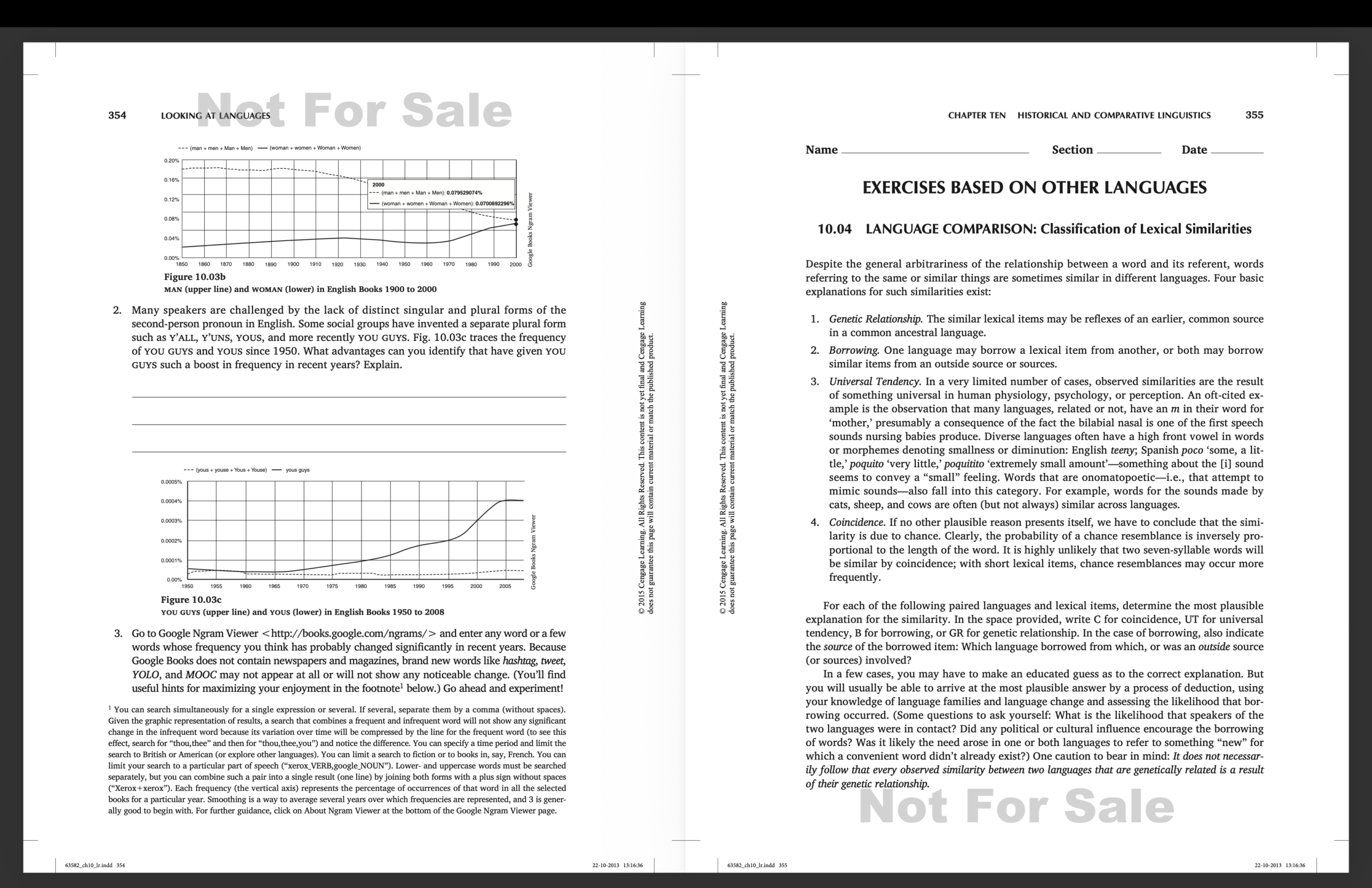
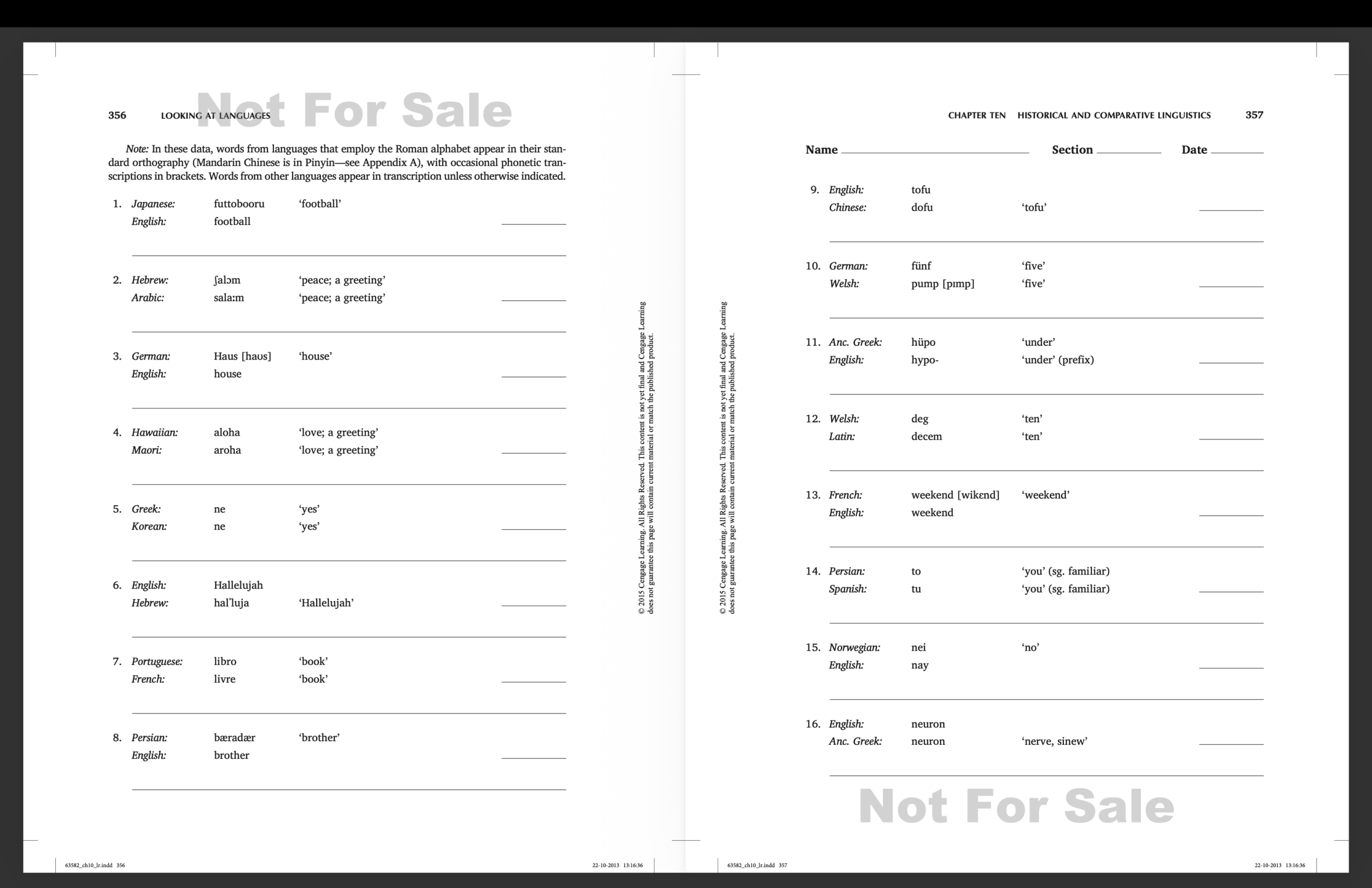
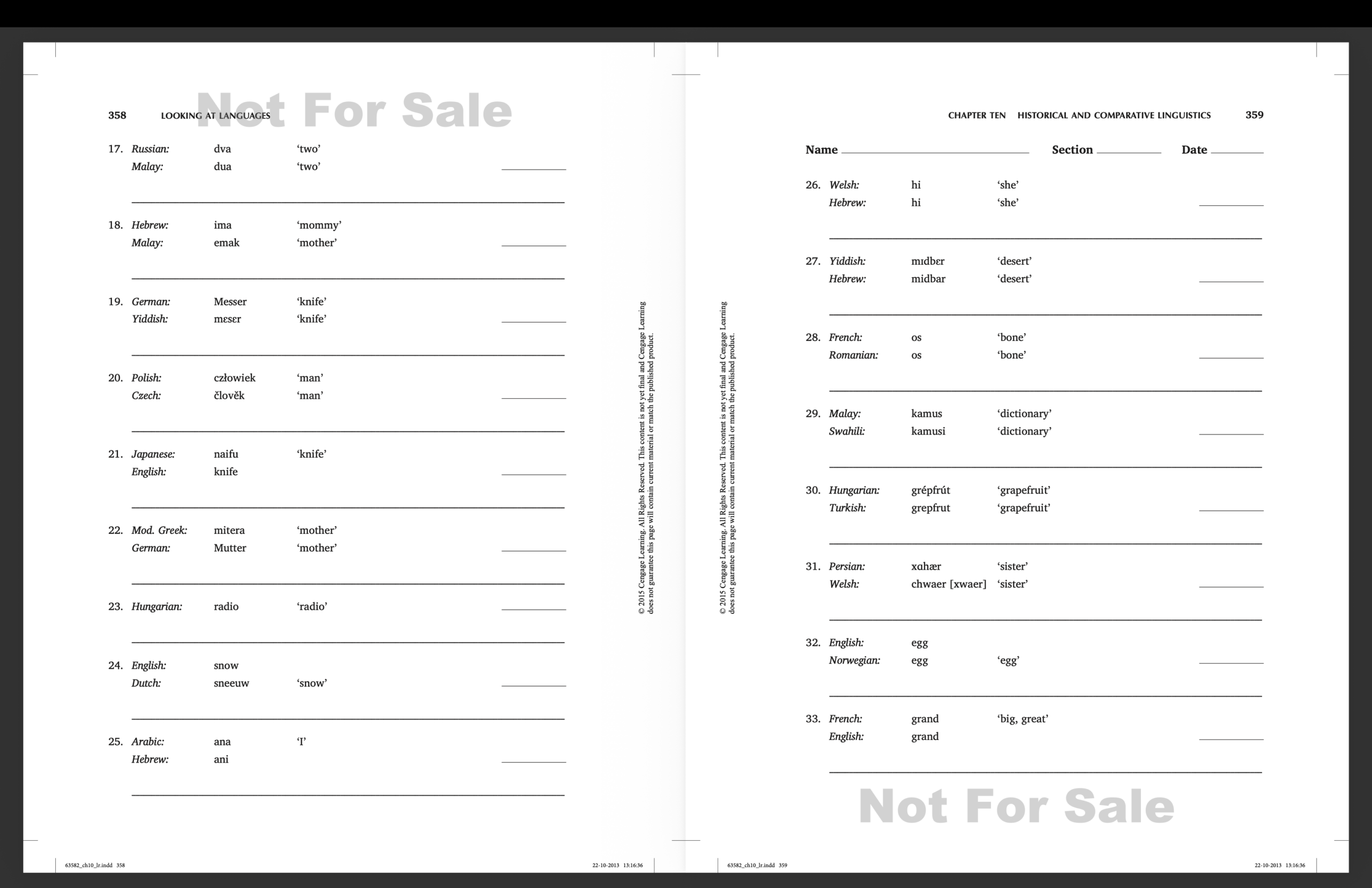
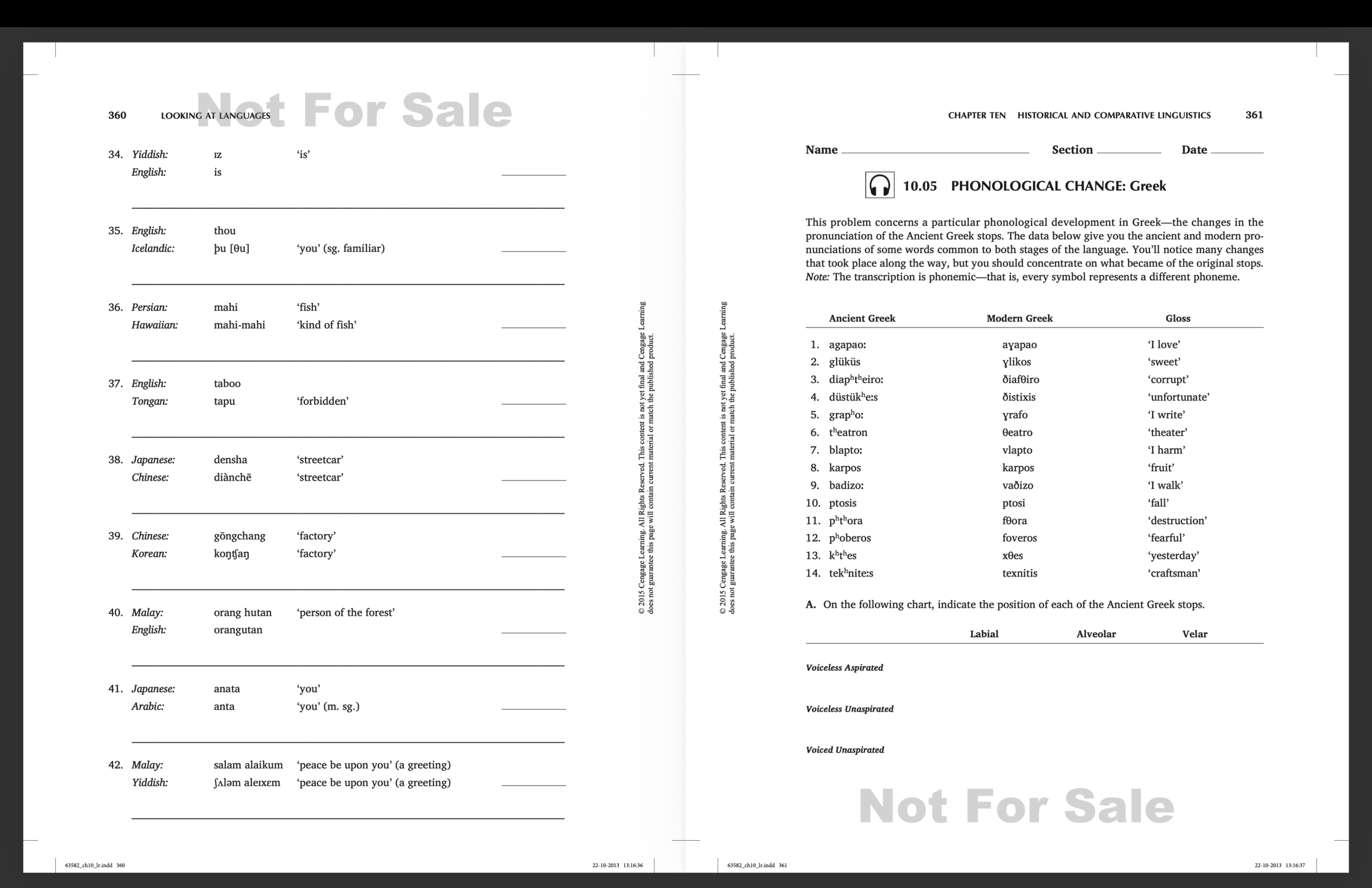
I thought I’d share this exercise with you from the linguistics workbook I wrote years ago with Edward Finegan, Looking at Languages. The idea is for students to look at similarities in different languages and decide how to explain them. Are the languages related, so that you would expect to see lots of similar things? Did one language borrow from the other? Could there be some universal tendency involved? Or is the similarity merely a coincidence? If you’re interested and you have some time, take a look! Make sure to read the introduction first. I’ve included the answer key, but don’t be tempted to check it until you’ve completed the whole exercise. Have fun!

Introduction

Items 1 – 16

Items 17 – 33

Items 34 – 42

Answers

1. B Japanese borrowed from English. 2. GR 3. GR 4. GR 5. C 6. B English borrowed from Hebrew. 7. GR 8. GR 9. B English borrowed from Chinese. 10. GR 11. B English borrowed from Greek. 12. GR 13. B French borrowed from English. 14. GR 15. B English borrowed from the ancestor of Norwegian. 16. B English borrowed from Greek. 17. C 18. UT 19. GR 20. GR 21. B Japanese borrowed from English. 22. GR 23. B Both borrowed from a third source. 24. GR 25. GR 26. C 27. B Yiddish borrowed from Hebrew. 28. GR 29. B Both borrowed from a third source (Arabic). 30. B Both borrowed from English. 31. GR 32. B English borrowed from the ancestor of Norwegian. 33. B English borrowed from French. 34. GR 35. GR 36. C 37. B English borrowed from Tongan. 38. B Japanese borrowed from Chinese. 39. B Korean borrowed from Chinese. 40. B English borrowed from Malay 41. C 42. B/GR Malay borrowed from Arabic, Yiddish borrowed from Hebrew. Hebrew and Arabic are genetically related.

Hayalovay!

ta P.

Posted in General | 17 Comments

Way Tìlalimä  The Windtrader Song

Ma eylan,

Ayngeyä kosmana aysäplltxeviri a teri tsapostì oeyä, seiyi irayo nìtxan! I always look forward to the useful and thought-provoking comments I get from the lì’fyaolo’. Thanks to everyone who wrote!

I’ll get to all those comments as soon as I can (including the ones from November!). But for right now, let me address Eana Unil’s question about the Tìlalim song, since I had forgotten to include that in the post.

Only one line of the song made it into the final cut of the film, and as often happens, that line underwent several transformations until it reached the form we all heard in Txep sì Txeva.

Here’s the recording:


And here are the words:

Txong hufwesru ’ulte, ulte ’efu nitram tawka.
‘The ship glides in the wind, and (we) feel happy across the sky.’

As you see, there are some new lexical items here.

txong (n.) ‘Windtrader airship’

sru (adp.+) ‘through’

Sru and kxamlä both mean ‘through’ and can sometimes be used interchangeably. But sru has the special connotation of moving inside and through a continuous substance, whether it’s water, air, or gel. So regarding the proverbial expression na kenten mì kumpay, ‘like a fan lizard in gel,’ i.e., being in an environment where you’re prevented from doing what’s natural to you, we could simply say,

Ke tsun kenten tswivayon sru kumpay.
’A fan lizard can’t fly through gel.’

To help you further distinguish these two adpositions:

    • Walking through the forest: better to use kxamlä. A forest is not a continuous substance.
    • A ship sailing through the water: better to use kxamlä. The ship is on the surface of the water, not inside it.
    • Swimming under water: better to use sru. You’re swimming inside and through a continuous substance.
    • A knife cutting through butter: better to use sru.
    • A yerik running through the grass: Debatable! Grass is not actually a continuous substance since it’s made up of individual stalks, but it can sometimes seem like an ocean. Either kxamlä or sru can be used here.

And finally:

’ulte (vin., ’ul.TE) ‘glide’

So there’s nice wordplay here with ’ulte followed by ulte.

Hayalovay!

Posted in General | 20 Comments